

Quick answer
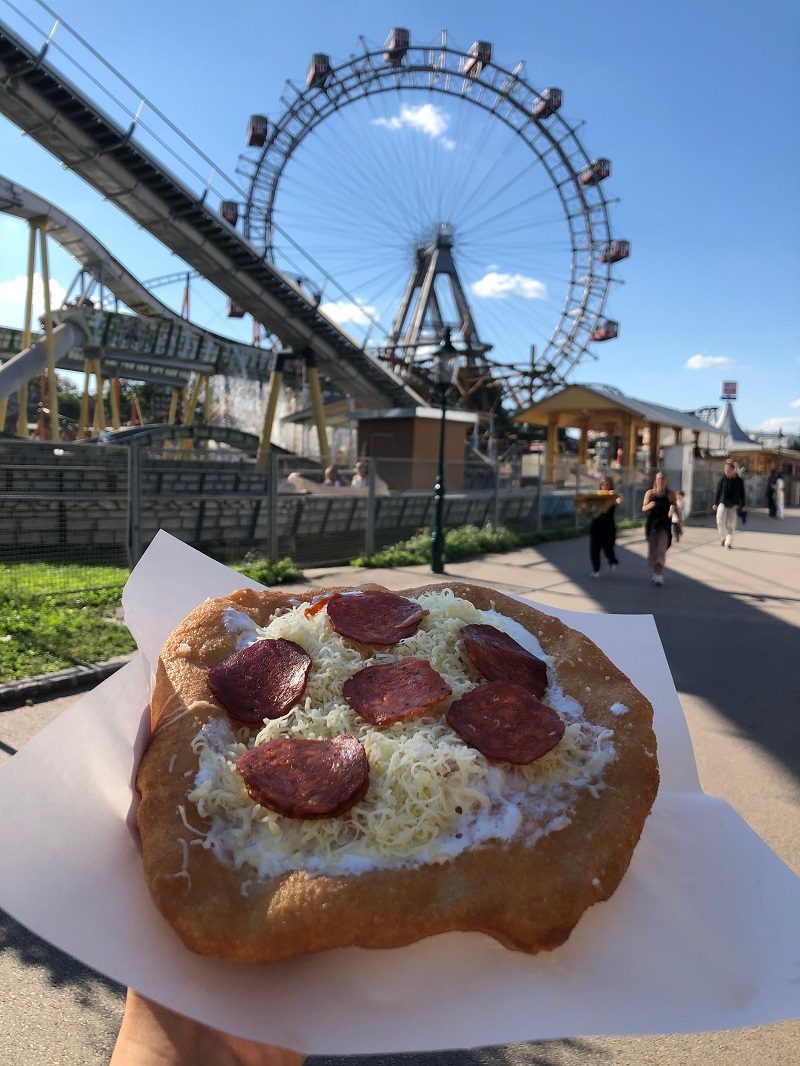
Traditional food in Vienna at Prater centers on Langos—deep-fried dough topped with garlic and sour cream—alongside Lebkuchen hearts, roasted chestnuts, Würstelstand sausages, and Kaiserschmarrn. Most food stalls operate daily from late morning through evening during the main season, with the widest selection available between 11:00 and 18:00 when seasonal vendors are open.
The Wurstelprater has served the same core menu since the late 19th century, when the imperial hunting ground opened to the public and vendors set up wooden stalls along the Hauptallee. What visitors find today is not a reconstructed theme-park version of Viennese cuisine but the living descendant of that original street-food economy, still run by multi-generational families who occupy the same plots their great-grandparents worked. Langos remains the signature dish—a Hungarian import that became a Prater fixture in the 1960s and now defines the park's food identity as much as the Riesenrad defines its skyline. The dough is fried to order in wide, shallow pans, brushed with garlic oil, and spread with sour cream or cheese. It is eaten standing, often as a first course before moving deeper into the park. Lebkuchen hearts, inscribed with phrases in white icing, hang from every second kiosk and have been the park's edible souvenir since the early 1900s. Roasted chestnuts appear in autumn, sold from charcoal braziers that scent the entire entrance plaza. Würstelstand carts serve Käsekrainer and Burenwurst with mustard and fresh horseradish, a combination unchanged since the interwar period. The food at Prater is not fine dining, but it is exact. Recipes are narrow, techniques are visible, and the margin for error is small when you are frying dough in front of a queue. The vendors who last are the ones who keep their oil clean, their portions consistent, and their counters open when the park is cold and empty. Traditional food in Vienna is often presented in quiet, formal settings—the Prater version is louder, cheaper, and more democratic, but no less specific about what it is. If you are visiting for the food, arrive during the midday window when all stalls are staffed and the fried items are coming out in steady rotation. The park is free to enter, so you can walk the length of the Prater Straße, compare vendors, and return to the one that looks most active. Seasonal timing matters—Lebkuchen production slows in summer, and chestnut vendors appear only from September onward. The food is the park's oldest continuous business, older than most of the rides, and it operates on the same logic it always has: high volume, low prices, and no unnecessary variation.
“The food at Prater is not fine dining, but it is exact—recipes are narrow, techniques are visible, and the margin for error is small when you are frying dough in front of a queue.”
Traditional Food in Vienna: Dining Options at the Prater
The Prater offers a spectrum of dining, ranging from historic, long-standing beer gardens to casual kiosks serving local snacks. While the park is famous for hearty traditional fare, visitors seeking more varied options can find local establishments just outside the main grounds.
Schweizerhaus
€€restaurant
Located centrally within the Prater, this venue is a landmark known for its expansive beer garden and serving traditional Stelze (roasted pork knuckle).
Lusthaus
€€€restaurant
Situated at the far end of the Hauptallee, this historic pavilion offers refined Viennese cuisine in a quiet, park-side setting.
Rollercoaster Restaurant
€€restaurant
Positioned near the main entrance, this venue delivers food via automated tracks, offering a modern contrast to traditional park dining.
Prater Kiosks
€street
Found throughout the park pathways, these stalls serve standard Viennese quick bites such as Würstel sausages and langos.
Operational Hours for Visiting Prater to Find Traditional Food in Vienna
The Prater park area is accessible to visitors daily. While the park grounds remain open throughout the day and night, individual food venues maintain their own operational hours.
| Monday | 00:00–23:59 | Park access |
|---|---|---|
| Tuesday | 00:00–23:59 | Park access |
| Wednesday | 00:00–23:59 | Park access |
| Thursday | 00:00–23:59 | Park access |
| Friday | 00:00–23:59 | Park access |
| Saturday | 00:00–23:59 | Park access |
| Sunday | 00:00–23:59 | Park access |
Entrance Fees for Traditional Food in Vienna at the Prater
Access to the Prater park area is free, meaning visitors do not pay an admission fee to walk through the grounds. Costs are limited to individual attractions and any food or drinks purchased at the various establishments.
A typical adult pays 0 EUR for park entry, with final costs determined solely by the attractions visited and food consumed.
Getting There: Accessing Traditional Food in Vienna via the Prater
The Prater is located at Prater 9, 1020 Vienna, and is highly accessible via the city's extensive public transportation network. The most direct approach is utilizing the U-Bahn system, which places visitors within short walking distance of the main dining areas.
U1 or U2 line to Praterstern station
S-Bahn lines S1, S2, S3, or S7 to Praterstern station
Line 5 or O to Praterstern station
Drop-off at Prater 9
Check availability
Common Questions About Traditional Food in Vienna at Prater
Everything you need to know about traditional food in vienna